HAVOC studied the role sea-ice ridges in the thinner ice pack in the Arctic Ocean. While the ice is getting thinner, the thicker parts of the ice cover are most likely to survive summer melt and provide the last habitat for ice-associated flora and fauna.
- Area:
- Type:
- Topic:
- Leaders:

Publications
Data sets
HAVOC team took part in the Multidisciplinary drifting Observatory for the Study of Arctic Climate (MOSAiC), an expedition that drifted across the Arctic Ocean for a year in 2019 to 2020, in a similar fashion than the Fram expedition lead by Fridtjof Nansen in 1893–1896.
The HAVOC project was funded by the Research Council of Norway and supported by the Centre of Ice, Climate and Ecosystems at the Norwegian Polar Institute.
Background
While sea-ice ridges constitute a significant part of the Arctic ice pack, there is proportionally little knowledge about the exact role in the sea-ice ecosystem. However, a few earlier studies indicated that they could play a vital role in the sea-ice ecosystem, with more diverse habitats. The MOSAiC expedition also provided the unique chance to study sea ice over a full annual cycle, which especially for evolution of the ridges has not been done before.
Hypothesis
The overarching hypothesis of HAVOC was to examine whether: Ridges harbor key ecosystem functions in terms of habitat and food web components for sea ice, under-ice and pelagic flora and fauna in the central Arctic. Pressure ridges will become an increasingly important component of the new Arctic sea ice regime dominated by thinner first-year ice where the largest portion of the level ice melts completely in summer.
Key findings
From a physical point of view, it was shown that ridges, piles of ice blocks at initial formation, evolve over time, and change their physical characteristics which has also implications for their role as habitat and ecosystem function.
There was new evidence provided that surface (snow) meltwater in summer can refreeze in ridge keels, and that in winter/spring it is even plausible that snow can enter through open leads and could possibly contribute to the rapid consolidation of ridge keels. Ridge keels limit the spreading of meltwater layers below the ice by acting as inverted dams and reduces the melt rates of level ice. It was also shown by repeated multibeam sonar surveys of the same ridges, that ridge keels typically melt 3-4 times faster than the level ice in summer. Using data from an earlier expedition it was also shown that ridge keels have the potential to provide more habitable space than the level ice, for ice associated primary producers. Overall, these different mechanisms paint a rather complex picture of how the physical characteristics of ridges evolve over time and seasons.
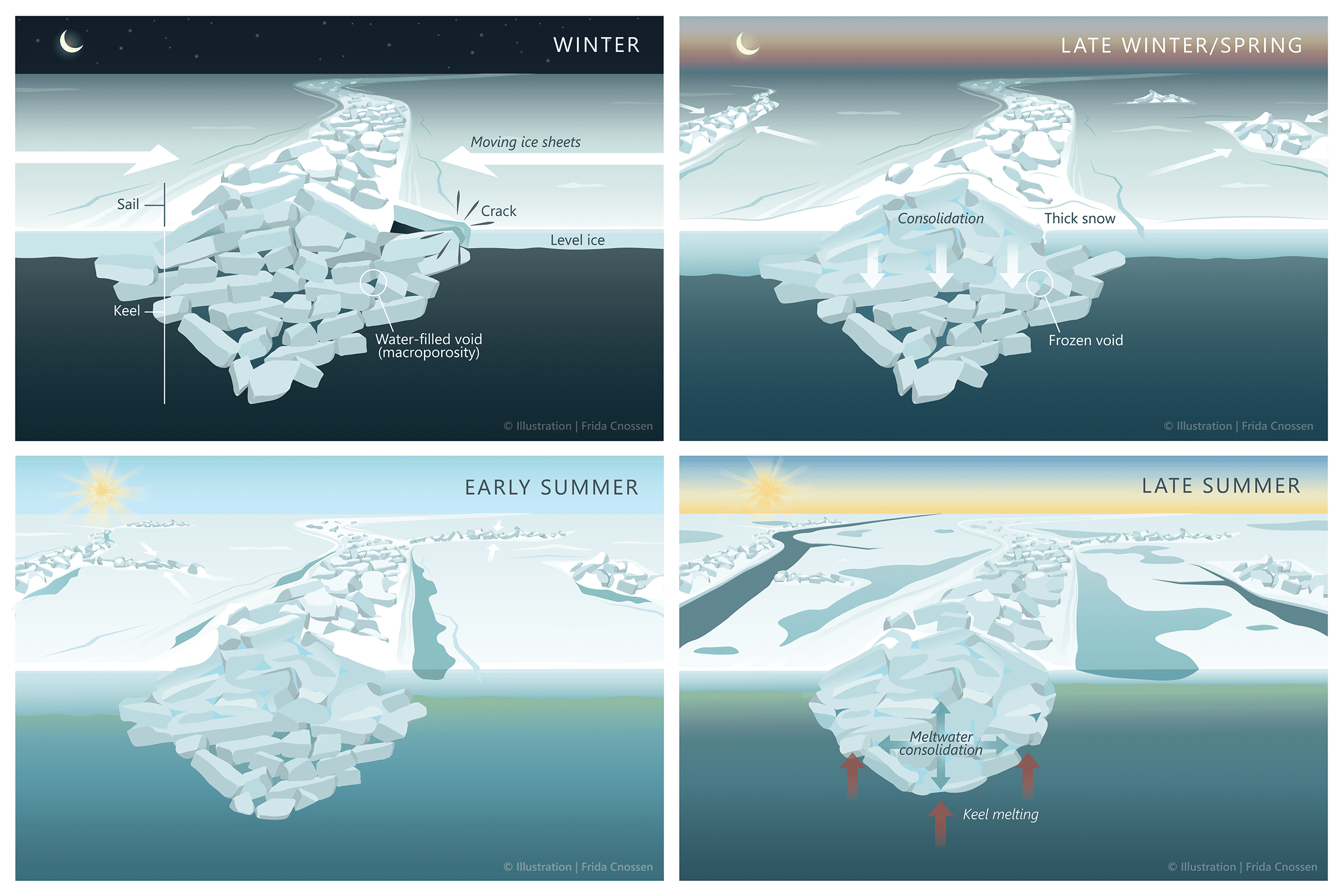
Schematic of seasonal aspects of the evolution of sea-ice ridges. Illustration: Frida Cnossen
From a biological perspective several interesting findings came out. It was postulated that in winter, when ridges form, the submerged ice blocks warm up to the temperature of the surrounding seawater, which means the ice blocks become porous and can release material formerly trapped in the colder ice. This could be a formerly unknown energy source for the pelagic organisms in the polar night, when there is too little light for primary production.
Mapping of the biomass in sea-ice ridges showed that in summer, the ridges could potentially contain nearly 80% of all the algae biomass in sea ice, even if their spatial coverage was only 22% and this is likely an overlooked aspect of the (Arctic) sea-ice ecosystem given there are so few observations from ridges. The consolidation, or freezing of water-filled voids, clearly impact the biological processes occurring in the ridges. Further, the ridge keels provide diverse microhabitats, such as ice blocks surfaces and water-filled voids, that can harbor distinct but also diverse microbial communities. Also bio-optical mapping of ridges indicated they could be biomass hotspots.
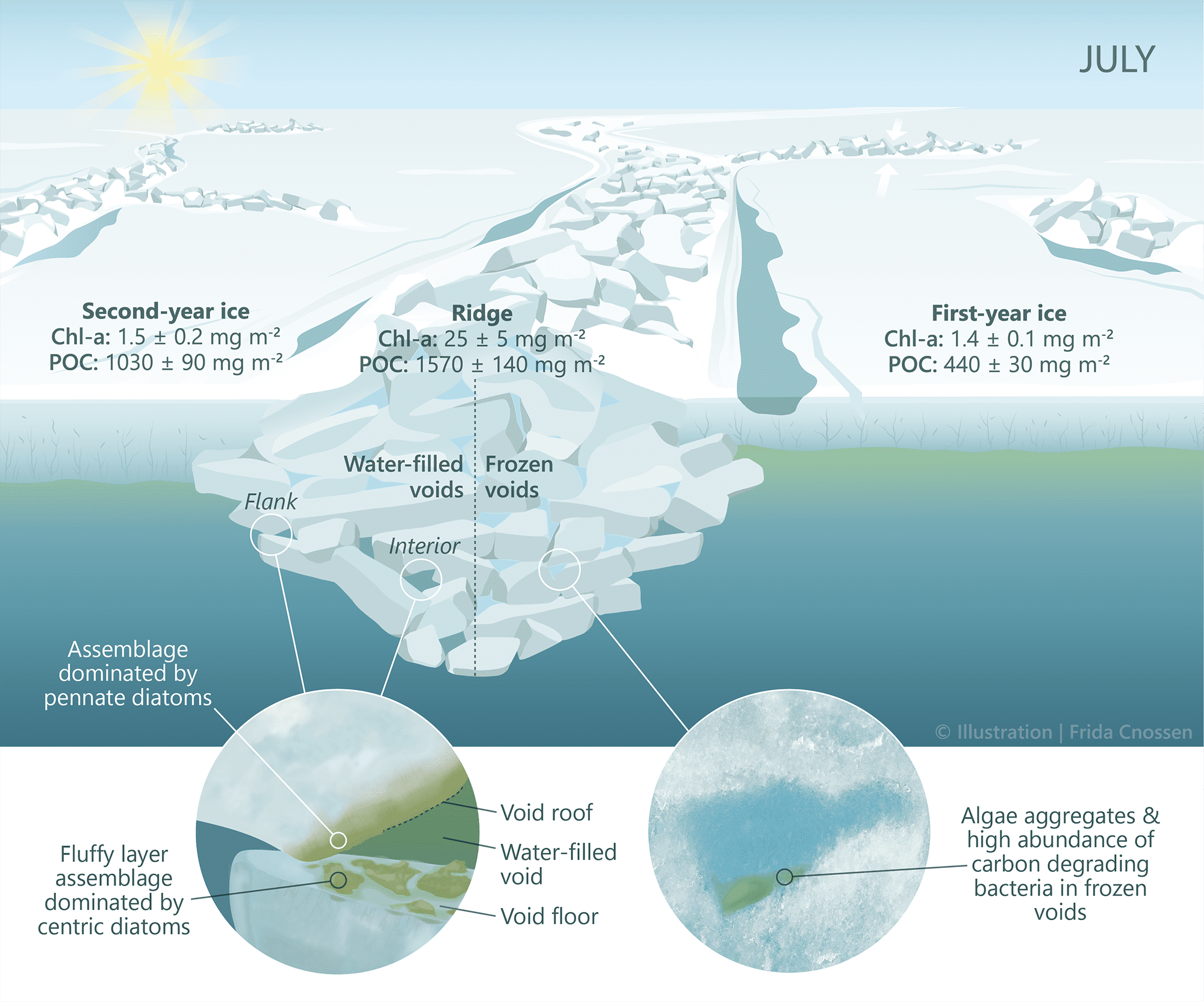
Schematic of sea-ice ridge microhabitats and the biomass in ridges versus level ice. Illustration: Frida Cnossen
Publications and further reading
- HAVOC poster on key findings
- Brief story on the work in the HAVOC project (EU Research magazine Spring 2024)
- HAVOC peer-reviewed publications
- HAVOC conference presentations and posters
Main objectives
Project outline
The work was carried out in four main work packages (WPs), each of these examined aspects of the sea-ice ridges that were integrated into a unified picture of the evolution of sea-ice ridges and their role. The body of the work was carried out during the MOSAiC expedition, and the plan was to establish a sea-ice ridge observatory and make regular interdisciplinary observations of sea-ice ridges throughout all seasons, using conventional observations, but also make use of new technology and instruments.

Illustration: Mats Granskog / Norwegian Polar Institute
WP1: Evolution of the physical environment in and around sea-ice ridges
In this task we will map the evolution of sea-ice ridges and examine factors such as ocean currents (mixing, heat and nutrient fluxes) and light climate in and around sea-ice ridges to see how this habitat differs from the typical level ice that is studied during MOSAiC.
WP2: Species diversity and distribution as a result of habitat diversity within and below pressure ridges
In WP2 we will assess the processes that cause differences in the diversity of ice associated biota (from viruses, bacteria, to zooplankton and fish) )between ridges and level sea ice. How does the complex geometry of the ridge keels, with ice blocks and water filled gaps, affect the biodiversity of ridges versus the more exposed level ice. Observations over a longer season also allows to examine how the role of ridges changes with season.
WP3: Biogeochemical processes and ecosystem functioning in ridges compared to level-ice and pelagic habitats.
In WP3 we will determine how food web and biogeochemical processes at the ice-ocean interface and the underlying water column differ between ridges and level sea ice, including bacterial and primary production, remineralization, proto- and metazoan grazing and vertical export in comparison with those of level sea ice.
WP4: Assessing importance of ridge processes on regional and pan-Arctic scales
And finally we will extend findings to regional and pan-arctic scales using local (conventional mapping and ship-radar), airborne (helicopter and fixed-wing) and satellite based observations and assess performance and improve representation of ridges in numerical models, especially for the role of the ecology of ridges.
The MOSAiC expedition
The role model for the MOSAiC expedition is Fridtjof Nansen’s famous Fram expedition during 1893-1896, which demonstrated the feasibility of letting a research vessel drift across the polar cap, driven by the natural drift of the sea ice. While Nansen has demonstrated the basic concept of such an expedition, the scientific measurements at that time were limited. The backbone of MOSAiC will be the year-round operation of research vessel Polarstern, drifting with the sea ice across the central Arctic from about October 2019 to October 2020. Our planned work in HAVOC is partly based on the findings from the N-ICE2015 drift expedition, with research vessel Lance, drifting in the pack ice north of Svalbard, but that also gave us experience to participate and conduct such work in harsh conditions.
Project members
Principal Investigator
Mats A. Granskog (Norwegian Polar Institute) project leader
Early Career Scientists
Jessie Gardner (UiT – The Arctic University of Norway)
Benjamin A. Lange (Norwegian Polar Institute)
Oliver Müller (University of Bergen)
Lasse Mørk Olsen (University of Bergen)
Evgenii Salganik (Norwegian Polar Institute)
Morven Muilwijk (Norwegian Polar Institute)
Project members
Nicole Aberle-Malzahn (NTNU)
Philipp Assmy (Norwegian Polar Institute)
Jørgen Berge (UiT – The Arctic University of Norway)
Gunnar Bratbak (University of Bergen)
Dmitry Divine (Norwegian Polar Institute)
Pedro Duarte (Norwegian Polar Institute)
Torbjørn Eltoft (UiT – The Arctic University of Norway)
Sebastian Gerland (Norwegian Polar Institute)
Rolf Gradinger (UiT – The Arctic University of Norway)
Knut Høyland (NTNU)
Aud Larsen (NORCE)
Eva Leu (Akvaplan Niva)
Marit Reigstad (UiT – The Arctic University of Norway)
Janne Søreide (UNIS)
Arild Sundfjord (Norwegian Polar Institute)
Pedro de la Torre (NTNU)
Anna Vader (UNIS)