Today marks 100 years since the expedition with the airship Norge departed from Ny-Ålesund on its journey over the North Pole. The anniversary is being commemorated with a visit from an Italian delegation.
The expedition, which took place in 1926, was carried out through cooperation between Norwegian, Italian, and American partners, and stands as a powerful and early symbol of international collaboration in the Arctic. One hundred years later, Ny-Ålesund remains an arena where cross-border cooperation is essential—now to understand and address global climate and environmental challenges.
“This anniversary is an opportunity both to look back on a truly distinctive chapter in our polar history and to lift our gaze toward the future. Today, the Norwegian Polar Institute operates the Ny-Ålesund Research Station, which is the world’s northernmost research station and settlement for international studies in the Arctic. This role involvesfollowing up and coordinating high-quality international research, in line with the strategy for Ny-Ålesund,” says Camilla Brekke, Director of the Norwegian Polar Institute.
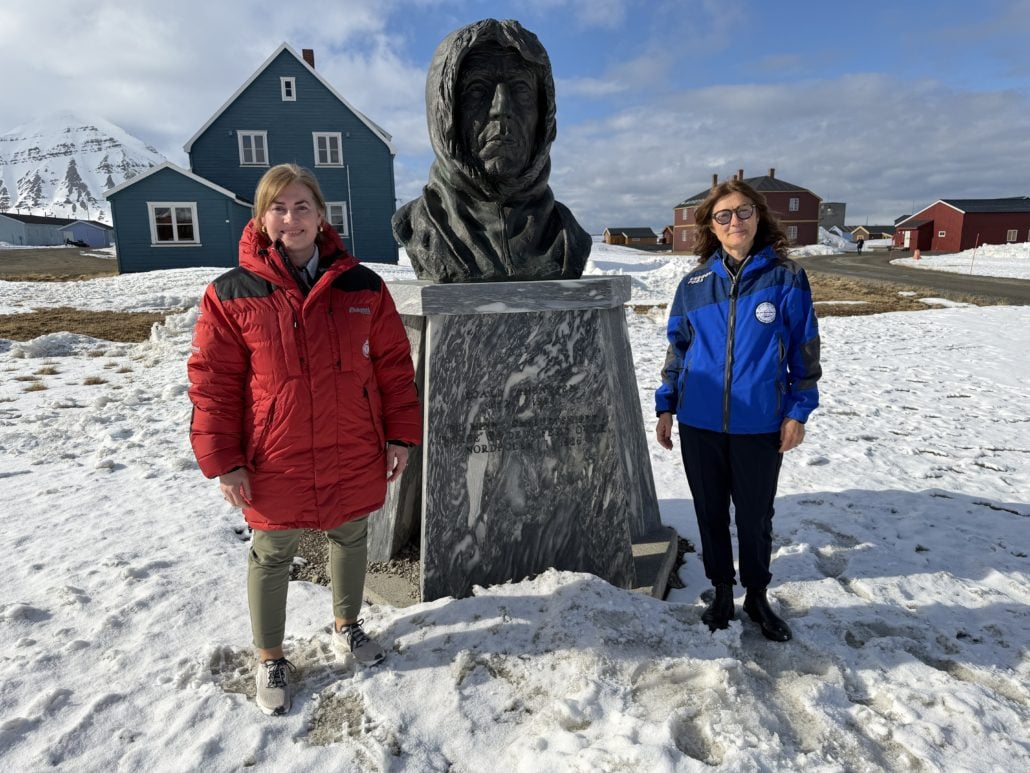
Director of Norwegian Polar Institute Camilla Brekke (left) in Ny-Ålesund together with the Director of the Institute of Polar Sciences of the National Research Council of Italy (CNR-ISP), Guiliana Panieri. Photo: Stig Mathisen / Norwegian Polar Institute
Continuing collaboration with Italy
The airship Norge was designed by the Italian Umberto Nobile, and the expedition was carried out in close cooperation between Nobile, Roald Amundsen, and Lincoln Ellsworth. Today, the Norwegian–Italian connection continues through extensive research collaboration in Ny-Ålesund, including work on climate, atmosphere, ice, and ecosystems. A large Italian delegation is visiting Ny-Ålesund today to mark the 100th anniversary of the airship expedition.
“For me, this anniversary connects past exploration with present responsibility. Today, the Arctic is not only a place to discover and exploit, but a complex system that affects life across the entire planet. This is why we must understand and protect it together. As a scientist, I wish we use science as our common language, enabling collaboration across borders to address complex environmental challenges. Strengthening partnerships with the Norwegian Polar Institute and Arctic colleagues is key to advancing this shared mission, because only by working together can we truly respond to the changes unfolding in the Arctic“, says Giuliana Panieri, Director of the Institute of Polar Sciences of the National Research Council of Italy (CNR-ISP).
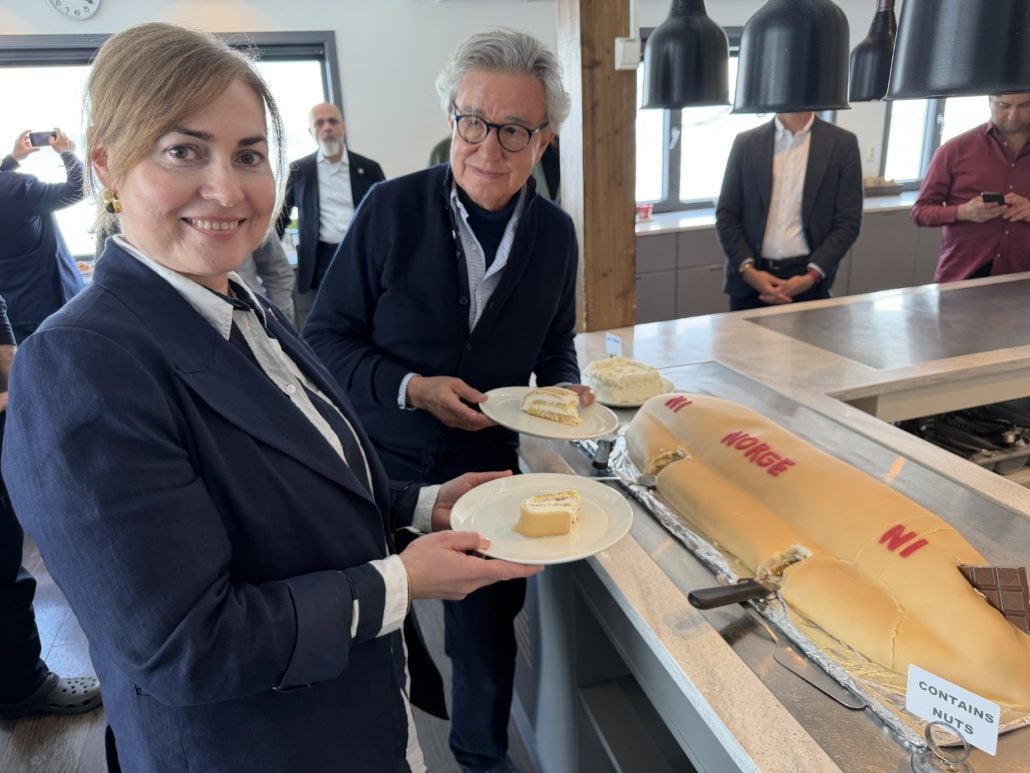
Director of the Norwegian Polar Institute Camilla Brekke together with the President of the National Research Council of Italy, Andrea Lenzi. The marzipan cake that was served was shaped like an airship. Photo: Stig Mathisen / Norwegian Polar Institute
The pursuit of knowledge that unites us
Climate change is happening faster in the Arctic than anywhere else on Earth, and understanding these processes requires long-term, coordinated, and trust-based collaboration.
“Today, international research cooperation is at the very heart of this research station. Scientists from a wide range of countries work side by side to build knowledge about the changes we are observing in the Arctic and what lies ahead. Representatives from several nations took part in the airship Norge expedition a hundred years ago. Today, theinternational interaction at the research station helps bind us together across institutions and national borders. This research community is truly unique on a global scale,” says Brekke.
2026 also marks the launch of the national research programme The Arctic Ocean 2050, a long-term Norwegian initiative to strengthen scientific understanding of a rapidly changing Arctic Ocean. The initiative extends through the fifth International Polar Year in 2032–33 and underscores the need for a coordinated global research effort—once againin the Arctic Ocean.
“In our time, as the Arctic Ocean shifts from white to blue in summer, the need for scientific exploration and up-to-date knowledge is critically important,” says Brekke.
About Arctic Ocean 2050:
Arctic Ocean 2050 is a ten-year research program bringing together the breadth of the Norwegian research community within a joint, interdisciplinary research effort. 18 Norwegian research institutions are participating. The program aims to provide fundamental and applied knowledge and skills that are urgently needed. Link to the web page.
About research in Ny-Ålesund:
The Ny-Ålesund Research Station on Svalbard organizes its scientific activity through four main programs known as flagships, designed to strengthen cooperation and coordination of research. These programs cover core polar environmental studies and are coordinated by the Ny-Ålesund Science Managers Committee (NySMAC).
The four flagships in Ny-Ålesund are:
- The Kongsfjorden System: Studies the fjord ecosystem, including sea ice, the seabed, and marine biology.
- Terrestrial Ecosystems: Studies land-based environments, including plants, animals, and soils.
- Atmosphere: Monitors air quality, climate, and meteorological conditions.
- Ocean and Marine Biology: Investigates marine ecosystems.


