His Royal Highness Crown Prince Haakon of Norway will pay an official visit to Japan from 1–4 June 2026. In this context, the Norwegian Polar Institute will sign a cooperation agreement with Japan’s National Institute of Polar Research.
The signing will take place during a seminar on 1 June, organised by Arctic Frontiers in cooperation with the Norwegian Embassy in Tokyo. The seminar will bring together leading representatives from science, business and policy, and marks a new step in the long-standing cooperation between Japan and Norway in the polar regions.
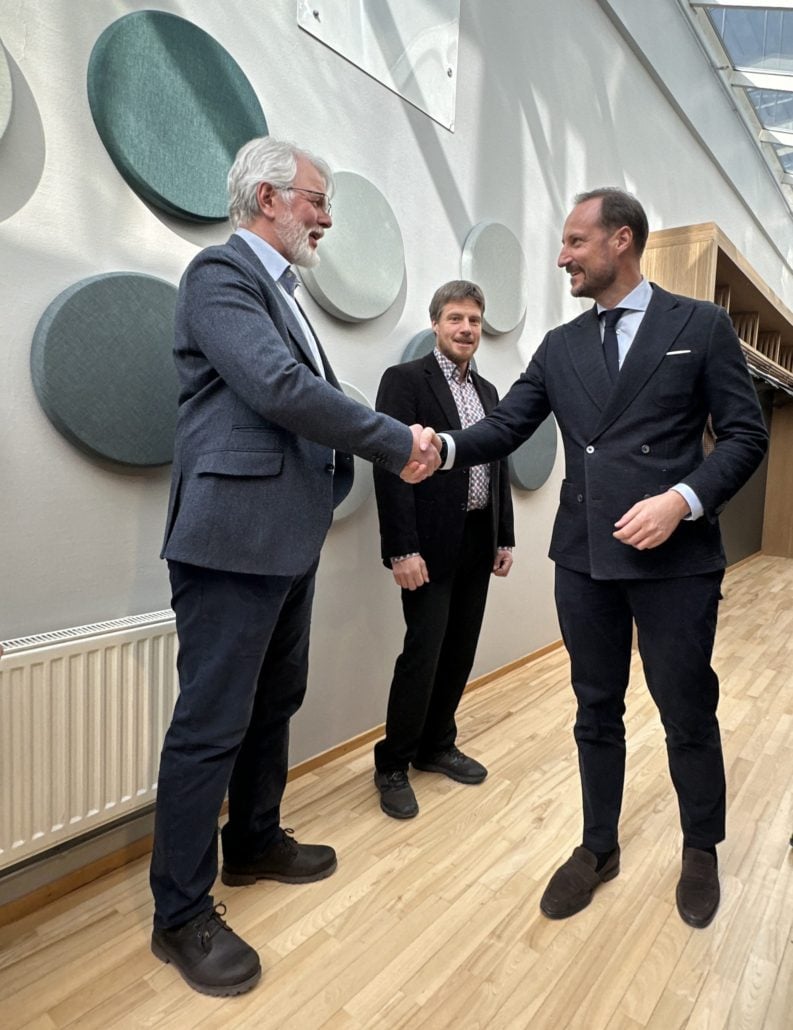
Crown Prince Haakon visited the Norwegian Polar Institute and the Fram Centre for an ocean seminar in April 2024. Here, he is greeting Arild Sundfjord, Programme Director for the Arctic Ocean. In the background is Tore Hattermann, Section Head at the Norwegian Polar Institute. Photo: Elin Vinje Jenssen / Norwegian Polar Institute
Building on more than 120 years of collaboration between the two countries, the seminar aims to facilitate further cooperation on solutions to global challenges, with the Arctic at the core of the dialogue.
The programme will open with a keynote address by His Royal Highness Crown Prince Haakon, followed by the signing of the agreement between the two polar research institutions. The agreement formalises and strengthens joint research efforts in both the Arctic and Antarctica.
Close collaboration in Arctic and Antarctica
Norwegian Polar Institute and National Institute of Polar Research (NIPR) have collaborated for several decades, including at the Norwegian research station in Ny‑Ålesund, where NIPR has been conducting research activities since 1991. Japanese researchers contribute broadly across atmospheric science, glaciology, terrestrial ecology and marine research.
NIPR is also a partner in the international RINGS project, led by senior researcher Kenny Matsuoka at the Norwegian Polar Institute, which maps the margins of the Antarctic Ice Sheet to reduce uncertainties related to future sea-level rise.
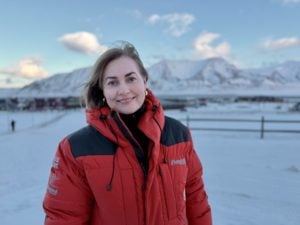
Camilla Brekke is the Director of Norwegian Polar Institute. Photo: Karine Nigar Aarskog / Norwegian Polar Institute
– The agreement with NIPR formalises a long and highly valuable collaboration, through which we have built knowledge in both the Arctic and Antarctica. NIPR’s long-standing presence in Ny‑Ålesund has been particularly important for advancing our understanding of Arctic climate and ecosystems. The RINGS collaboration demonstrates how international efforts are essential to reducing uncertainty about changes in the Antarctic Ice Sheet, with global implications for sea level and climate, says Camilla Brekke, Director of the Norwegian Polar Institute.

Director of NIPR, Yoshifumi Nogi. Photo: NIPR
“Norway and Japan have built a strong track record of collaboration in polar research over many years. This agreement builds on those achievements and will further advance cooperation between the two countries. To address the rapidly changing polar environment, we will strengthen international collaboration and partnerships and promote sustainable, integrated polar research for the future,” says Dr. Yoshifimi Nogi, Director of NIPR.
Strengthening the effort in the Arctic Ocean
The seminar will also include a fire side discussion on research collaboration in the Arctic Ocean, based on the new national research programme Arctic Ocean 2050. Two additional panel discussions will address issues related to ocean observations, technology and Arctic security.
As Arctic sea ice continues to retreat, both the Norwegian Polar Institute and NIPR are strengthening their research efforts in the Arctic Ocean. The forthcoming cooperation agreement will facilitate further collaboration at a time when the need for shared knowledge development in the polar regions is greater than ever.
– This agreement strengthens our shared foundation for future research in the polar regions, Brekke adds.

RINGS aims to achieve comprehensive mapping of grounding-line depth around Antarctica. The mapping is carried out using airborne radar. These data are crucial for producing more accurate estimates of present-day and future global sea-level change. Photo: Kenichi Matsuoka / Norwegian Polar Institute


